Eternal: Chronicles of the Throne Review
In Eternal: Chronicles of the Throne, the combat strategy is the defining aspect of the game. Most reviews frame Eternal as a generic and derivative deckbuilder and shrug at the combat. Here is the review it should have gotten.
July 4, 2026
A fierce, combat driven deckbuilder built around decision making in the attack left combat system. It shines best at three players.
In almost any review of Eternal: Chronicles of the Throne, you find the same conclusion. There is a river market. You thin your deck to make it more performant. You build toward combos. It is, the verdict goes, an okay deckbuilder that does not do much you have not seen before in Star Realms or Ascension. Rating noted, move along.
That framing of the game is not wrong so much as it is looking at the wrong things. The combat system, and the decision making it brings to the fore, is the entire reason this game exists. Describing Eternal by its deckbuilding alone does it a significant injustice. Designer Paul Dennen, the mind behind Clank, highlighted in the designer diaries for the game that combat decision making was a key design element. A big part of that decision making is around blocking vs not, and what that means for the flow and state of the game. Judge the game on that key conceit and it is a different, better game than most of its reviews suggest. This is the review I think it should have gotten.
Note: I will not be covering the full mechanics of the game in this article, and assume you have some familiarity with the game.
What It Is
Eternal: Chronicles of the Throne is a 2–4 player competitive deckbuilder from Dire Wolf Digital and Renegade Games, released in 2019 and adapted from Dire Wolf’s digital CCG Eternal. The two occupy the same universe, but Eternal: Chronicles of the Throne is not a straight port of the digital game. Each player starts at 25 health. All cards in hand are played during a turn. Some cards grant Power, which buys units, spells, and artifacts from a shared market to improve a small starting deck. Players attack with those units until one player is left standing. Games run about 30–45 minutes at two players. A single expansion, Gold and Steel, adds a secret personal market and weapon equipment, but those will be highlighted more in a future article.
If that summary sounds a lot like many other deckbuilders, that is exactly the trap. The deckbuilding is just the scaffolding. The game really happens in the combat.
A Single Attack
Here is one swing, start to finish. This player has played their hand, which included three units and two Diplomacy cards, which grant Power to purchase cards from the market.
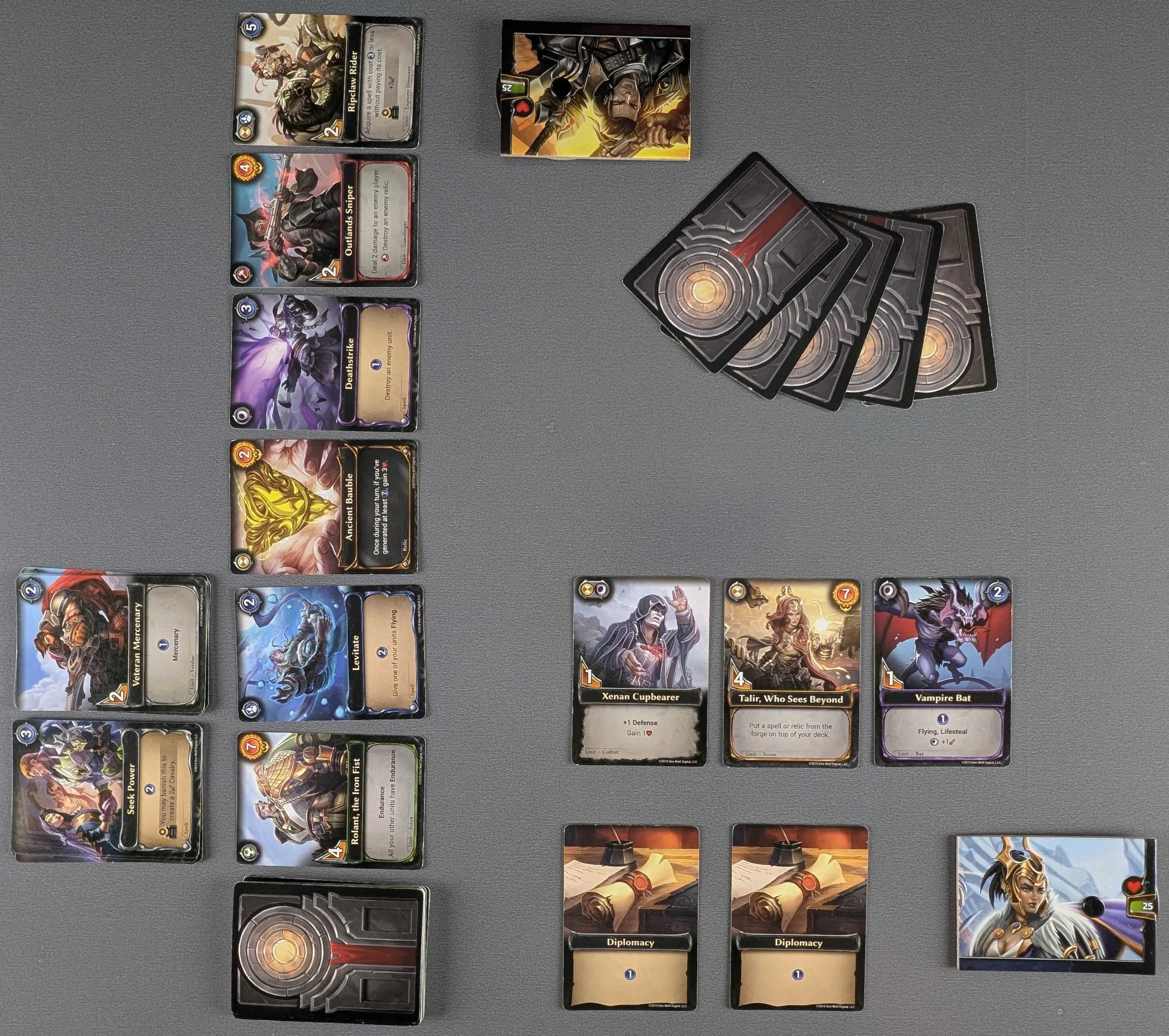
Let’s assume for this example that it’s a three player game, and there are no units currently coming in to attack this active player. So all units will stay on the table attacking the next player to the left. Units have a strength value. To block an attacking unit, your opponent must block with a unit of equal or greater strength, and when they do, both units are spent and go to the discard pile. Block a 4 with a 5, and you have traded your 5 to neutralize their 4. Decline to block, and the attack lands as damage straight to your health. In the example above, the opponent will be faced with a 1 strength, a 4 strength, and a 2 strength unit with Flying and Lifesteal. In the next frame, we’ll see what the opponent has in their hand to deal with this.
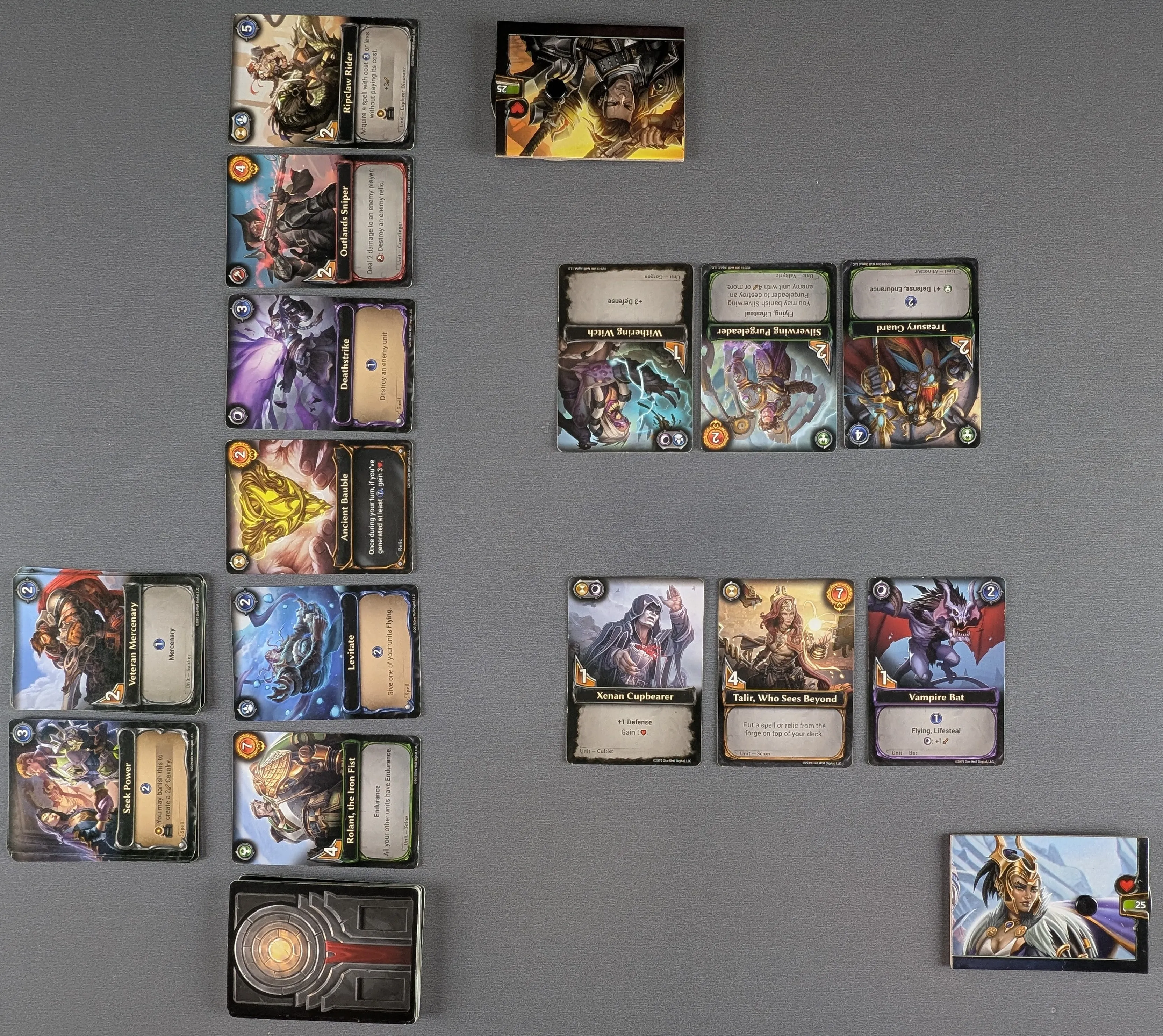
We can see that the next player is well equipped to fend off the incoming attacks. They have a 1 strength unit that gains +3 strength when defending. This becomes an obvious choice to eliminate the incoming 4 strength unit. They also have a 2 strength unit with Endurance activated. This allows them to block with that unit, but keep it on the table to then attack down the line. Finally, they have their own 2 strength unit with Flying and Lifesteal, which could self-eliminate to destroy any incoming unit with 4 strength or more. This would be another option for dealing with the 4 strength unit coming at them, but also allows them to potentially block the Flying unit that is attacking.
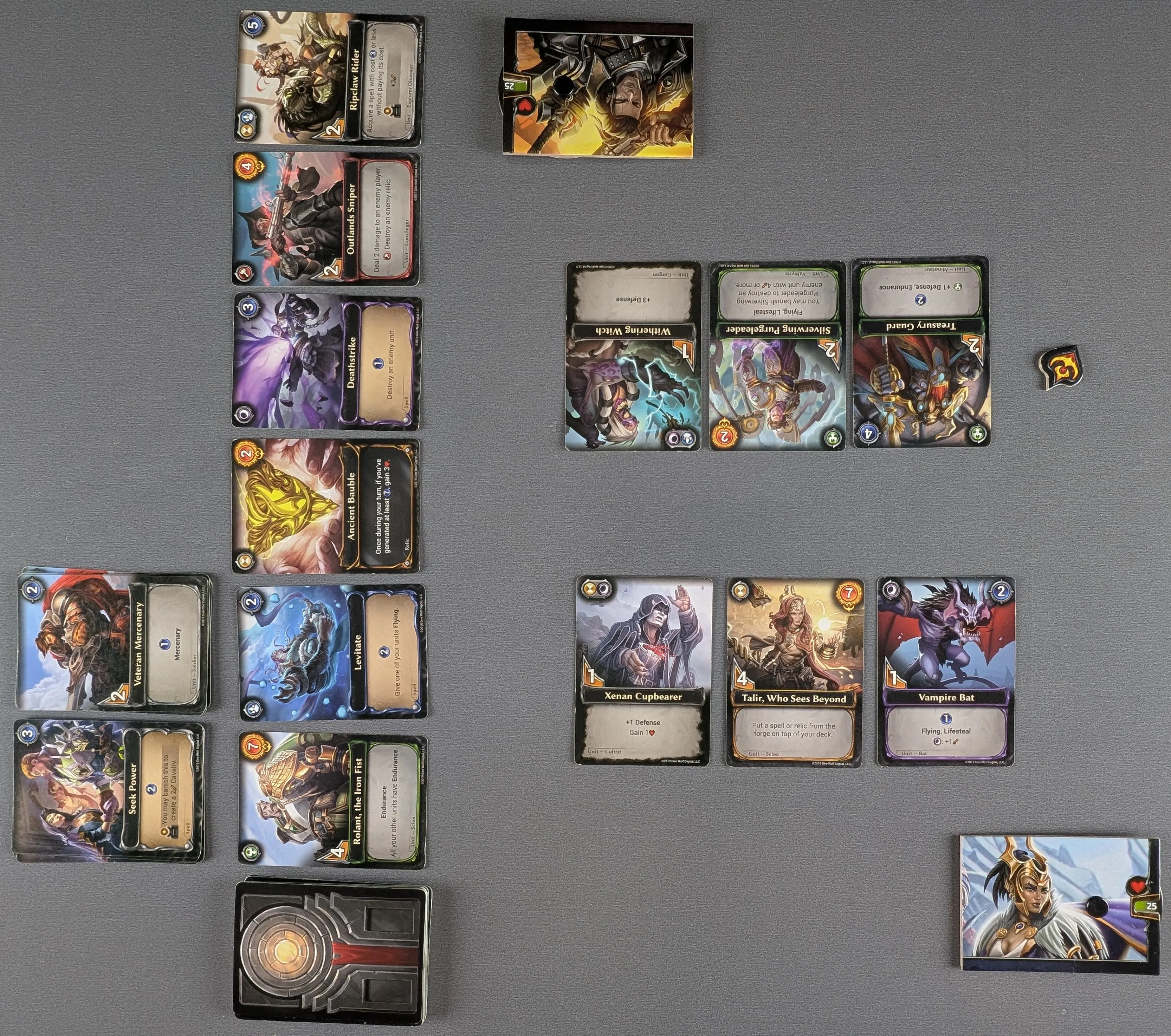
But wait, there’s another dynamic to the combat that is worth calling out here. The current player has access to an unspent Warp Token, and enough Power available to “flash in” a unit into play. Players get two of these per game, and they are mostly consumed for the remainder of the game (there is a way to renew them, but it happens infrequently in my experience).
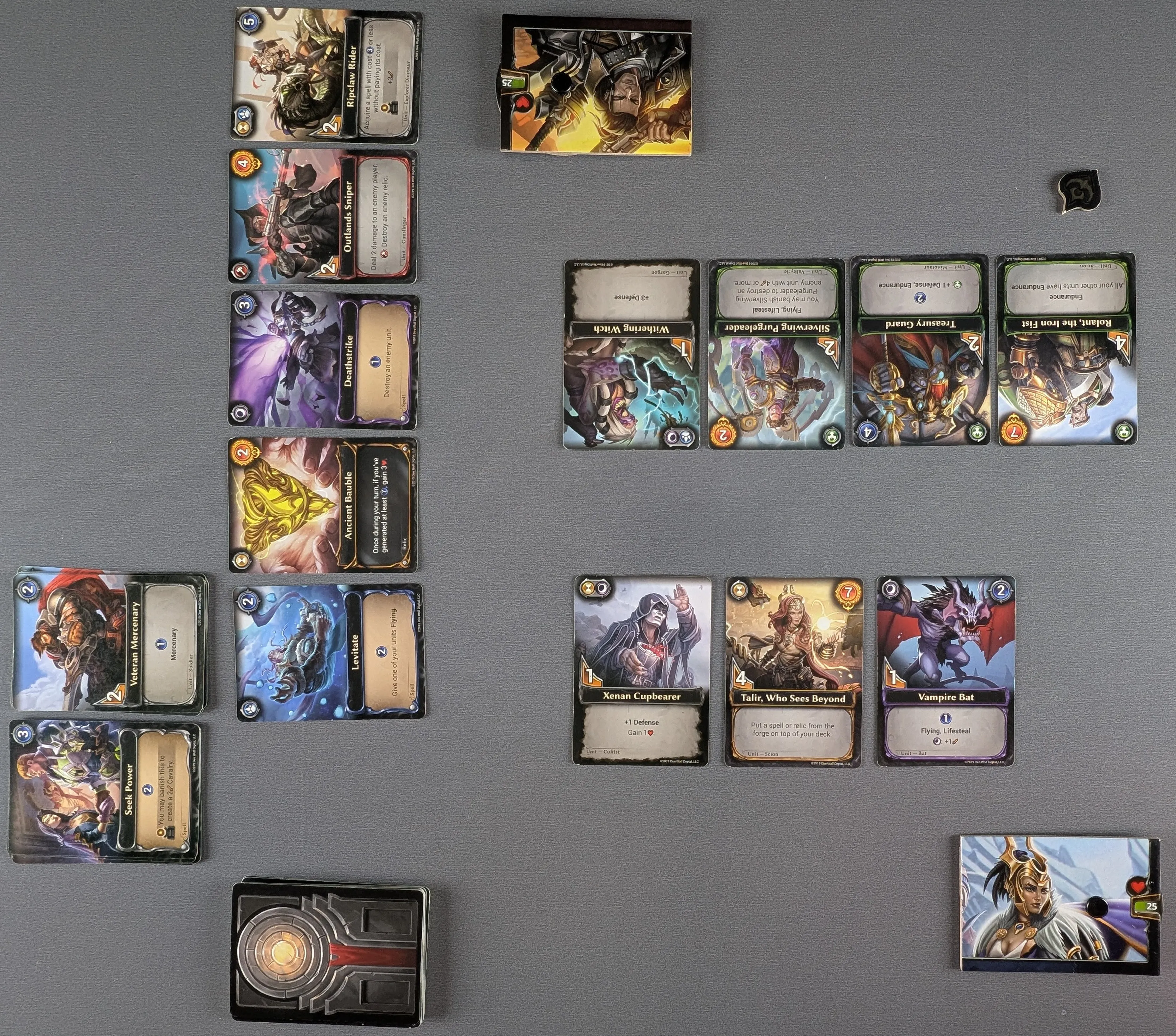
They opt to consume their Warp Token and purchase and play Rolant, The Iron Fist. Rolant also has Endurance, and he gives every other unit Endurance as well. With this play, the current player can now freely block all incoming units, and preserve all of their own to swing at the player to their left. Was this the right decision?
Why the Combat Makes the Game
Two rules turn that single attack into a genuine dilemma, and both sound procedural enough that a one-game reviewer skates right past them.
You must play your entire hand every turn. Nothing is held back. You cannot sandbag a fat blocker in hand and wait for the right attack to absorb. You cannot hedge. Every unit you draw becomes a binary choice this turn: send it left to attack, or keep it home as a blocker against what is coming from your right. Same card, two mutually exclusive jobs, no option to defer the choice. This one rule is what converts “you can block” from a description into a forced choice. Because it reads like a fiddly hand-management clause, it is the easiest thing in the rulebook to underrate.
Attacks go left and pressure comes from the right. Units auto-attack the player on your left, and you are attacked by the player on your right. The consequence of this is quiet but deep. Blocking spends a unit that can no longer attack, so a defensive choice on one side of the table ripples around to the offense on the other. At three players this is where the game really opens up. The table becomes a loop of pressure where easing off one neighbor potentially frees them to lean hard on the next, and every block is a small concession that someone else has a chance to exploit to their benefit. Three players is the sweet spot because the positional table read matters directly. If you choose to block heavy and attack light at your opponent, you are freeing them up to attack heavy at the player who would be attacking you. They are now faced with the blocking dilemma, and you may be free to swing for the fences at your opponent next turn.
The example we highlighted above also shows that this loop can be unexpectedly short-circuited. Rolant dropping on the table and granting significant Endurance means that player can fully attack and block. This likely threw a wrench into the whole table state that now has to be dealt with by the other players. Reviews that called this “interactive combat” and moved on did the game a disservice. The interaction is not a feature bullet. It is the game, and there’s a lot of depth to be had in how it’s played with the wide variety of faction play styles the game offers.
A Nuanced Read
Speaking of the factions, they each lean into a clear identity, and it’s advantageous to focus on a small number of factions for your deck. Customization can be less than a deckbuilding veteran might want based on this min-maxing. That is a fair knock on the game, but also intentionally supportive of the combat decision making. The consistency allows you to read an opponent’s likely attacks and blocks from what they have bought, and that readability is what makes the combat a contest of decisions rather than a guessing game.
The bigger caveat is that the combat feels awkward on a first play and only really clicks after a few games. The block or attack rhythm is unintuitive until your instincts adjust, which I suspect is the real reason so many reviewers defaulted to the generic-deckbuilder read. They met the game once, the fight felt clumsy, and the familiar market stuff was the part that landed. If you bounce off the first game, that is expected, not a verdict. Also, other reviewers recommend playing at two players, which is absolutely the wrong decision. The combat feedback loop is still present at two players, but it is less robust, and the game plays more shallowly as a result.
Three-player richness is also fragile. A player elimination drops the game straight to a duel. The bounty rule, where the player to the eliminated player’s right gains +5 health and a free forge card, can hand someone a real power swing at exactly the wrong moment. And the standard deckbuilder caveats still apply. There is absolutely luck in the draw. If a player has manipulated the table state such that they swing hard at you, and you have a hand full of junk, you’re going to have a bad time. But all games must end at some point.
Who It’s For
If you want a combative, head-to-head deckbuilder where the tension lives in managing the board state through combat decisions, Eternal delivers something most of its genre does not. It’s tough to find any deckbuilder that centers dynamic combat. My play group and I played the heck out of Fantasy Flight’s Rune Age, and when the decks grew stale we spent years creating our own custom decks. Eternal fills that combat-heavy void for the genre. If you want deep deckbuilding customization, sprawling combos, or a tidy low-conflict engine you build in your own corner, this is not that game.
Give it three games before you decide. The first one will feel like the deckbuilder everyone else reviewed. Somewhere in the second or third, the fight takes over, and the trade row recedes into the background as you calculate how to make the combat flow in your favor. That is the game Dennen built, and it is worth meeting it on its own terms.