Crown Your City in Capitals of Tactoria
A card-based kingdom builder six years in the making, Capitals of Tactoria cruised past its funding goal on Gamefound and is unlocking stretch goals fast. Here's what the campaign offers and how the game plays.
June 15, 2026
Capitals of Tactoria is a card-based kingdom builder from designer Henrik Lennartsson, currently live on Gamefound. The campaign easily cleared its funding goal early. As of this writing the campaign has more than double its target, with hundreds of backers and a string of stretch goals already unlocked. It’s the first large-scale production run for a game Lennartsson has been passionately refining for about six years. This campaign caught my attention because I love complex card-based games, and the theme and art look fantastic. I also really enjoy backing true indie projects and bringing games with smaller fulfillment into my gaming group.
The campaign runs through June 29, 2026.
How It Plays
In Capitals of Tactoria (1–4 players, ages 14+) each player builds a personal city tableau and races to win one of two ways: maxing out your capital city to claim the top-tier Victory Upgrade (declaring your city the Capital of the Empire), or militarily destroying your rivals’ cities. Every turn you play cards to add buildings, troops, and mercenaries. Buildings are played face up as visible structures that telegraph some of your plans. Troops and mercenaries are played face down beneath them, so opponents can see how many you hold but not what they are. That blend of open and hidden information lets you read a rival’s intentions without ever being certain of them, and turns each move into a question of whether to expand your income or, as the campaign puts it, “raise your walls.”
Two upgrade engines run at once. You can combine cards to upgrade individual buildings into stronger versions. A Watchtower reinforced by a Ranger and an Archer becomes more than the sum of its parts. You also push your capital up a four-tier upgrade track. Reaching the top is the Victory Upgrade itself, so every step is both a power boost and a move toward winning. The track branches, with or/and choices opening multiple viable paths up. Bigger isn’t automatically better. A smaller, well-constructed city can outplay a sprawling one through efficient combinations and timing.
Mercenaries are the hidden wildcard. Hired with coin and recruited face down, each carries a distinct ability: boosting construction and combat, slipping behind enemy walls, or settling permanently under a building for an ongoing effect. They are revealed only when the moment is right. Many also carry quests. Fulfill the quest requirement and you draw from the Legendary deck, the game’s most powerful cards.
A turn flows through three phases. Build: play cards and upgrade your city. Military: declare attacks and resolve battles. Regroup: reposition units, discard down, and draw. The threat of combat is ever-present, but is driven completely by player choice. Troops fight with attack and defence slots. The defender adds City Defence, and the winner razes enemy buildings in proportion to the margin of victory. A large enough margin levels the capital and knocks that player out. The key consideration is balance between kingdom building, capital upgrades, and the tactical use of force. Setup is billed at one minute, which is definitely appealing for a complex game.
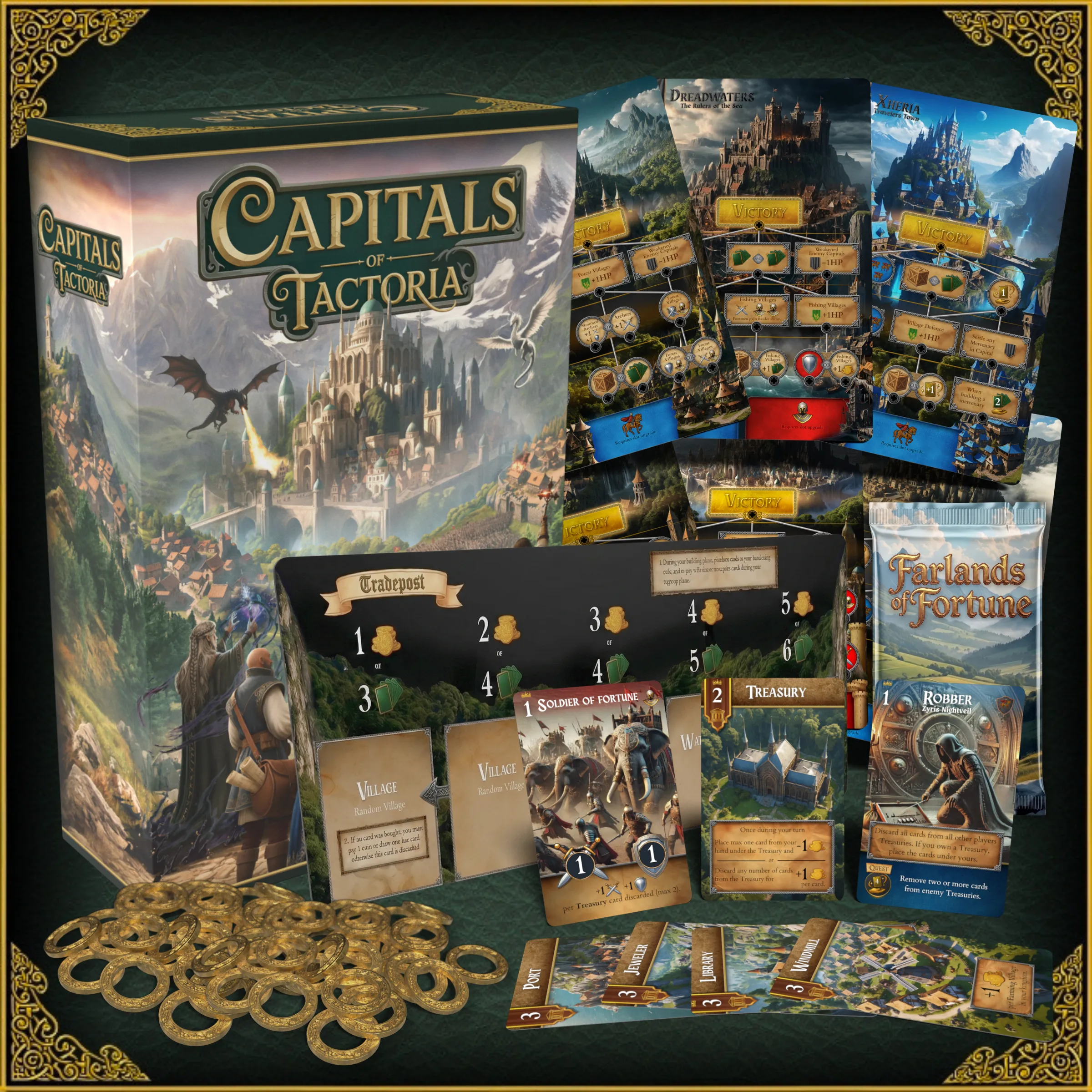 A spread of Capitals of Tactoria components — capital boards, building, troop, and mercenary cards — alongside elements from the Tradepost and Farlands of Fortune expansions.
Players and Modes
The game supports 1 to 4 players. An automa handles single-player games against an automated opponent, and a team-battle mode unlocked during the campaign opens things up beyond a free-for-all. Several of these modes arrived as funded stretch goals rather than base content, so the final package is larger than the original pledge. Cards are printed in English, with rulebooks available in English, French, German, Italian, Spanish, and Polish.
Who’s Behind It
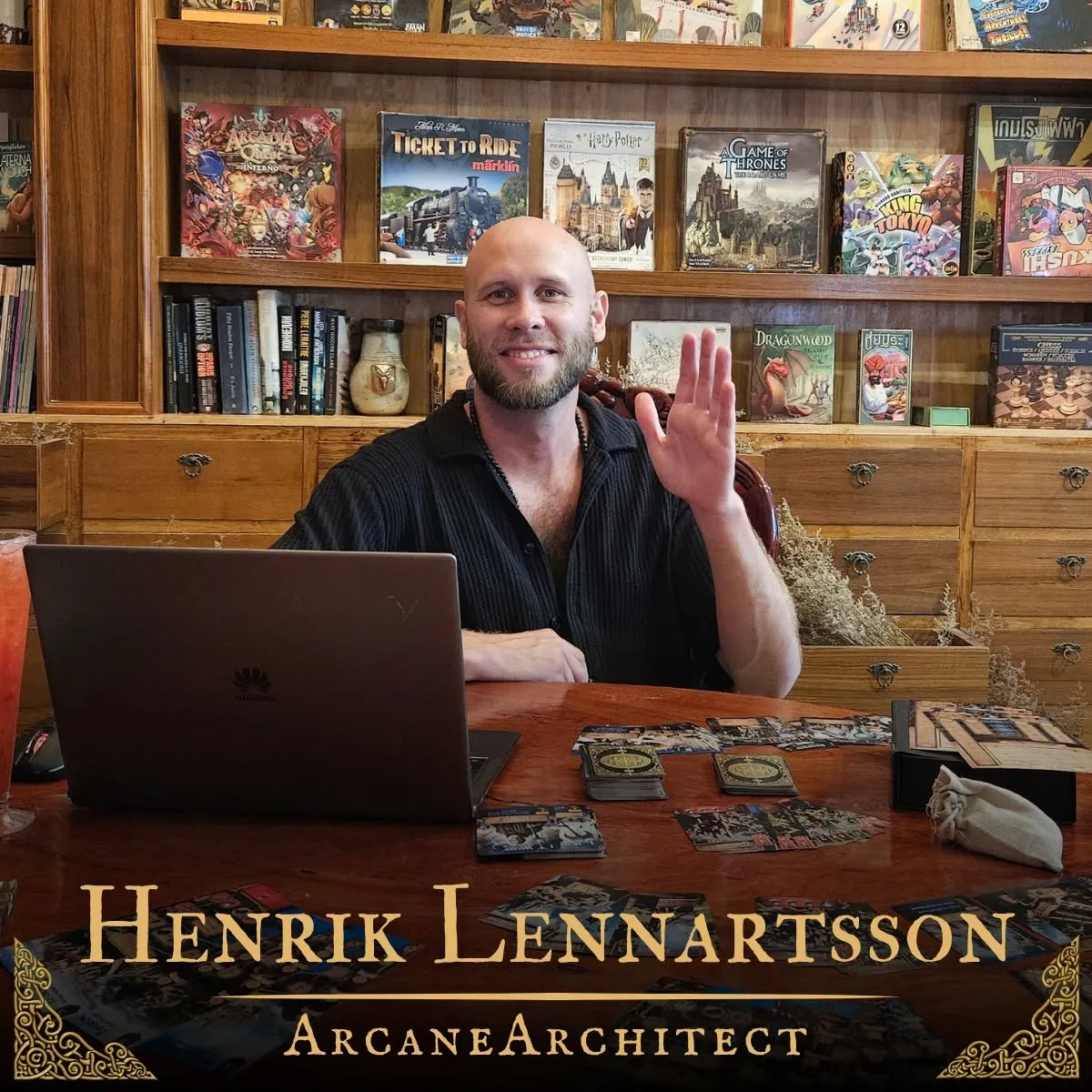 Henrik Lennartsson — designer, graphic designer, and campaign lead, known online as ArcaneArchitect.
This is very much a creator-led project. Known online as ArcaneArchitect, Lennartsson is handling design, graphic design, print coordination, and the campaign itself under his Tactoria Studios label. The six-year development arc shows in how complete the production looks for a first run indie effort.
Pledge Levels
- Tactorian Pioneer — €55: The complete base game plus all unlocked stretch goals, plus a “Council of Tactoria” seat granting early access to digital expansions, print-and-play content, and a say in future add-ons.
- Grand Champion — €65: All Pioneer rewards plus three Expansion Cities — Xheria, Elfenheim, and Dreadwaters, each with its own tech tree. Also the Tradepost expansion for an added layer of complexity.
- Lord of the Farlands — €79: Everything in Grand Champion plus the Farlands of Fortune expansion and its “Save & Steal” economy. This is the most-backed tier.
- Sovereign Emperor — €135: The full all-in gameplay collection with deluxe components — metal markers, custom sleeves, and royal velvet bags — plus your name in the official rulebook.
A €1,500 Legendary Backer tier lets you name a core hero or co-create a character and lore for the upcoming Masters of the Craft expansion, and a separate pledge is available for verified retailers.
Stretch Goals
Stretch goals unlocked so far include premium card upgrades, additional cards, updated Automa support, and team battles, with legendary cards and a deluxe box upgrade teased as upcoming targets.
If a fast-setup, combo-driven kingdom builder that plays anywhere from solo to four is your kind of game, the Gamefound campaign is worth a look before it closes on June 29.
Media provided by the publisher.