Game Overview
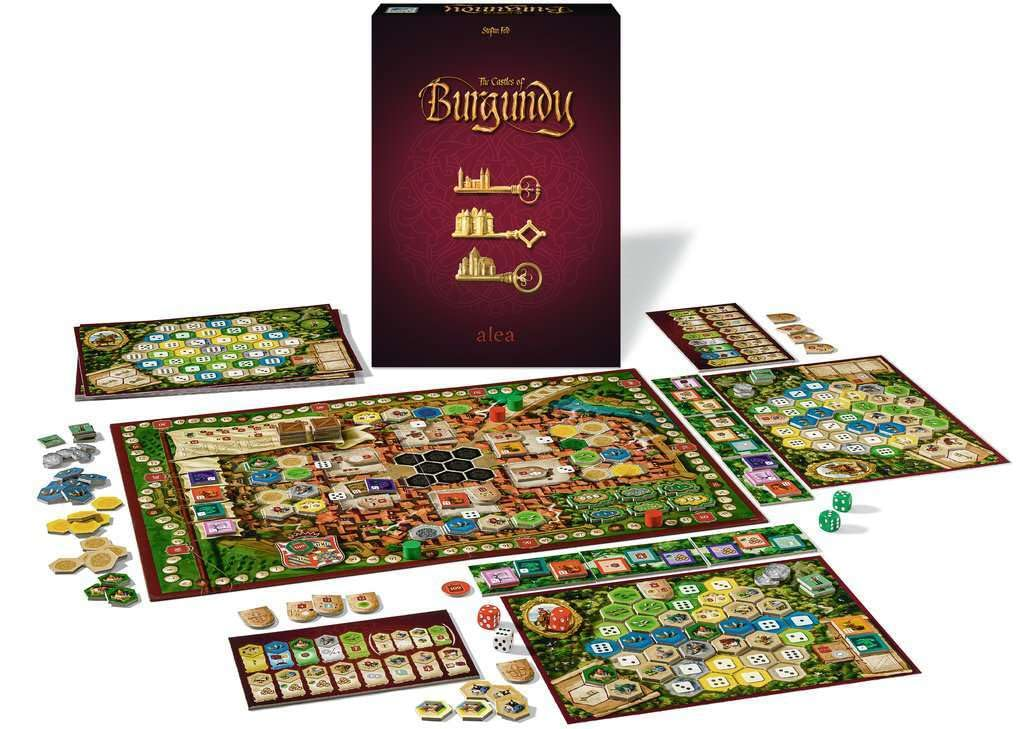
Castles of Burgundy is a well known and well regarded game in the board gaming community that I’m just finally getting around to playing. At first glance, the game looks like an intimidating heavy Euro style game, but under the covers lurks a deceptively simple gameplay loop that makes play smooth while retaining significant strategy.
Each player is given a player board that represents their estate that must be grown with a variety of improvements, from mines, to farmland, to castles. The central play board consists of areas demarcated by dice numbered 1 through 6, and a central area with no number. The number areas contain tiles that can be acquired and placed into your estate, and also areas where goods are placed for acquisition through shipping (more on that later).
The central board also has a game round tracker, and a tracker of who will play first each player round. Each game round consists of six player rounds within it.

There are three “resources” available in the game. These are the two dice players roll each turn, workers, and silver coins. On a player’s turn, they roll their dice and use the numbers showing on them to acquire and place tiles, gain workers, or sell goods.
Getting a tile into your estate is a two step process of acquiring the tile from the central play area into a staging area of three spaces on your player board, and then playing them from there into your estate. You acquire to your player board primarily by spending a die that matches the number where a tile is that you want. This is where workers come into play. A worker allows you to modify your die face by one, plus or minus, giving you more flexibility.
The other way to acquire tiles is to spend silver coins to gain tiles in the center of the central play area. This does not use up a die, but the tiles go into your staging area as normal.
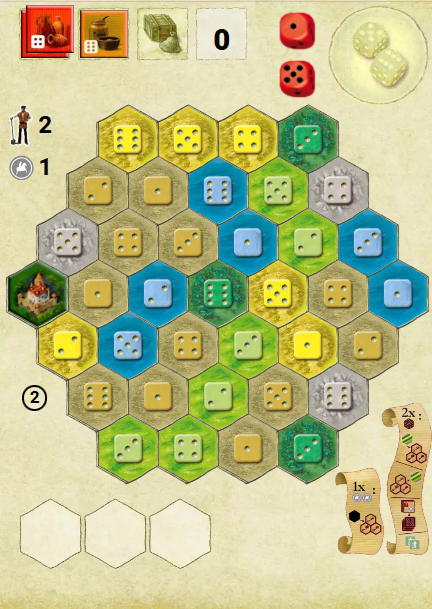
The goal of Castles of Burgundy is to gain the most points, and there are a few ways to gain points. One of the biggest scoring options is to complete colored regions on your player board by filling them with tiles. When you do this you score points based on the game round, with early completions worth much more than later completions. If you are the first to cover all of a certain color, you gain a five point reward. If you are the second player to cover that color, you gain a two point reward.
Another way to gain points is by acquiring gold tiles that grand end of game points based on certain conditions. These are variable, but many gain points based on having other tiles in your estate, so you will want to strategize around that, and also pay attention to what your opponents are going for. Sometimes denial is valuable, especially in two players.
The third primary way of gaining points is by selling goods. This is done by using a die matching the space of the good in your goods track (can be modified by workers). You start with a some goods, and gain more by placing ship tiles, which allow you to take the goods from one goods space in the central play area. Placing a ship also advances your marker for player turn order. This is an extremely important part of the game, because it can make or break your ability to get the tiles you need by going first in a new game round for example. It is possible to have back-to-back turns by manipulating the player turn order.

Finally, every two workers and every silver coin at the end of the game grant one point. The game ends after the last player round in the sixth game round.
General Impressions
Castles of Burgundy has a very intense gameplay feel. You are always in urgent contention with your opponents for scarce resources, and must strategize and prioritize how you will get what you need or work with what you have access to. There are a lot of moments where you groan as an opponent takes exactly what you needed to make a whole plan work. This isn’t an indictment on the game, far from it. It is very satisfying when a well-laid plan comes together. Every action is meaningful, even if only to set up a future action.
BGA Particulars
Playing on Board Game Arena takes care of a lot of busy upkeep. Every round new tiles have to be doled out in specific ways, and new good tiles have to be selected. Each player round good tiles have to be moved into a central area based on a die roll. It’s nice not to have to manage that upkeep.
It’s also helpful to have hard enforcement of what you can and cannot purchase with the workers you have available, and tile placement limitations in regions.
As always automatic scoring is nice, and in this case the game also keeps track of who achieves the completed region type goals, so there’s no forgetting about that.
Fun Factor
Castles of Burgundy ended up being much more fun and compelling than I expected going into it. The variety of strategies and paths you can take toward victory give the player a lot of agency to play a fulfilling game. It is definitely a game I will play regularly when given the opportunity.
Next Up
For my next spotlight, I’ll be taking a look at a pretty new game, River Valley Glassworks. I just picked this game up in physical copy, and have played a few rounds already on BGA as well.



 I'd Rather Be Board Gaming
Leave a comment